


Table of Contents
The future of law firms amid shifting client expectations 1
A new client mindset that is reshaping the future of law firms 2
How modern legal practice trends are reshaping firm operations 2
Matter delivery as a coordinated team effort 2
Data driven matter management 2
Rising expectations around transparency 2
Where technology fits into the future of law firms 3
The rise of AI supported workflows 3
Collaboration ecosystems gaining importance 3
Most discussions about the future of law firms start with technology. However, the true force reshaping the market is the shift in how clients evaluate and engage external counsels. Clients have become more cost conscious, more metrics-driven, and far more vocal about efficiency gaps. This shift has created a pivotal moment for law firms that want to stay competitive. They are being pushed to reexamine how they operate, how work flows across teams and how knowledge is shared internally. Only then can technology meaningfully support their goals.
A new client mindset that is reshaping the future of law firms
Across global markets, client expectations have widened beyond high quality legal advice. Corporate clients want faster turnaround, greater predictability, and clearer alignment with business outcomes. Clients expect deeper commercial understanding from their legal partners, and view responsiveness and project management to be as equally important as technical expertise.
For independent firms, this signals something crucial. The future of law firms depends on how well they reorient their internal operations to deliver consistency, transparency, and measurable value. Expertise alone is no longer the differentiator it once was. What matters is the ability to show clients how work progresses, how budgets are monitored, and how risks are managed throughout an engagement.
How modern legal practice trends are reshaping firm operations
The future of law firms is becoming more operationally intensive. Law firms are exploring structured matter workflows, centralized data visibility and standard approaches to managing engagements. These changes are not happening for efficiency alone. They help firms create more predictable outcomes; something clients increasingly demand.
Matter delivery as a coordinated team effort
The traditional partner led model is giving way to more collaborative structures. Associates, knowledge teams, pricing specialists, and project managers now contribute throughout a matter lifecycle. Clients appreciate seeing how this team-based approach keeps work on track and reduces surprises. It also supports the broader future of law firms by reducing dependence on individual expertise and elevating institutional knowledge.
Data-driven matter management
One of the most significant modern legal practice trends is the shift toward more structured use of matter data combined with AI assisted insights. Firms harnessing AI-powered legal matter management are beginning to unlock practical insights about how matters unfold in real time, which stages absorb the most effort and where misalignment can emerge across teams. This creates a more predictable delivery environment for both the firm and the client. Over time, consistent data habits—supported by AI—help firms strengthen transparency, refine budgeting conversations, and reinforce long-term client confidence.
Rising expectations around transparency
Clients want clearer scoping, phased budgets, and timely status updates. Email updates alone no longer satisfy these requirements. Firms that can surface real time progress data and offer a structured window into matter activity are better positioned to stand out.
Where technology fits into the future of law firms
Technology in legal services is not about replacing practitioners but about amplifying the efficiency and visibility of their work. Law firms are becoming more selective about the tools they bring in. Instead of adopting isolated applications, many now prioritize platforms that integrate seamlessly with existing systems and maintain a single source of truth for matter, financial, and client data.
The rise of AI-supported workflows
AI-driven law firms are beginning to use models that help streamline administrative tasks, identify deviations in scope, surface early risk indicators, and guide teams back to standardized processes. These capabilities strengthen internal consistency, reduce manual overhead, and support smoother delivery across offices and practice groups.
Collaboration ecosystems gaining importance
Firms that operate internationally need consistent, fast-moving collaboration. Integrated cloud environments enable collaboration platforms that allow teams to share knowledge securely, maintain real time communication, and connect matter updates to financial data. These environments also create audit trails and allow stakeholders to track progress without manually gathering information.
This shift toward unified technology frameworks is not simply a tool decision. It signals a cultural move toward transparency and shared accountability. The future of law firms will be shaped heavily by how well they unify communication, knowledge, and financial controls into one ecosystem.
Real world scenarios that reflect emerging expectations
Scenario 1
A client requests a mid-matter briefing to understand why their litigation budget is trending higher. In a traditional setup, partners scramble to gather spreadsheets from finance teams while associates backtrack through emails. In a modernized environment, all phases, time entries, and cost projections appear in one centralized dashboard. The partner offers clarity in minutes, not days. This responsiveness strengthens client trust and positions the firm as operationally mature.
Scenario 2
A cross-border team is assigned to a regulatory transaction. Without integrated systems, each office stores updates independently, causing misalignment. With a unified cloud environment, collaboration becomes frictionless. Teams see the same matter data, updates sync automatically, and the client receives consistent guidance regardless of geography.
These examples capture how the future of law firms increasingly revolves around operational predictability and transparent collaboration.
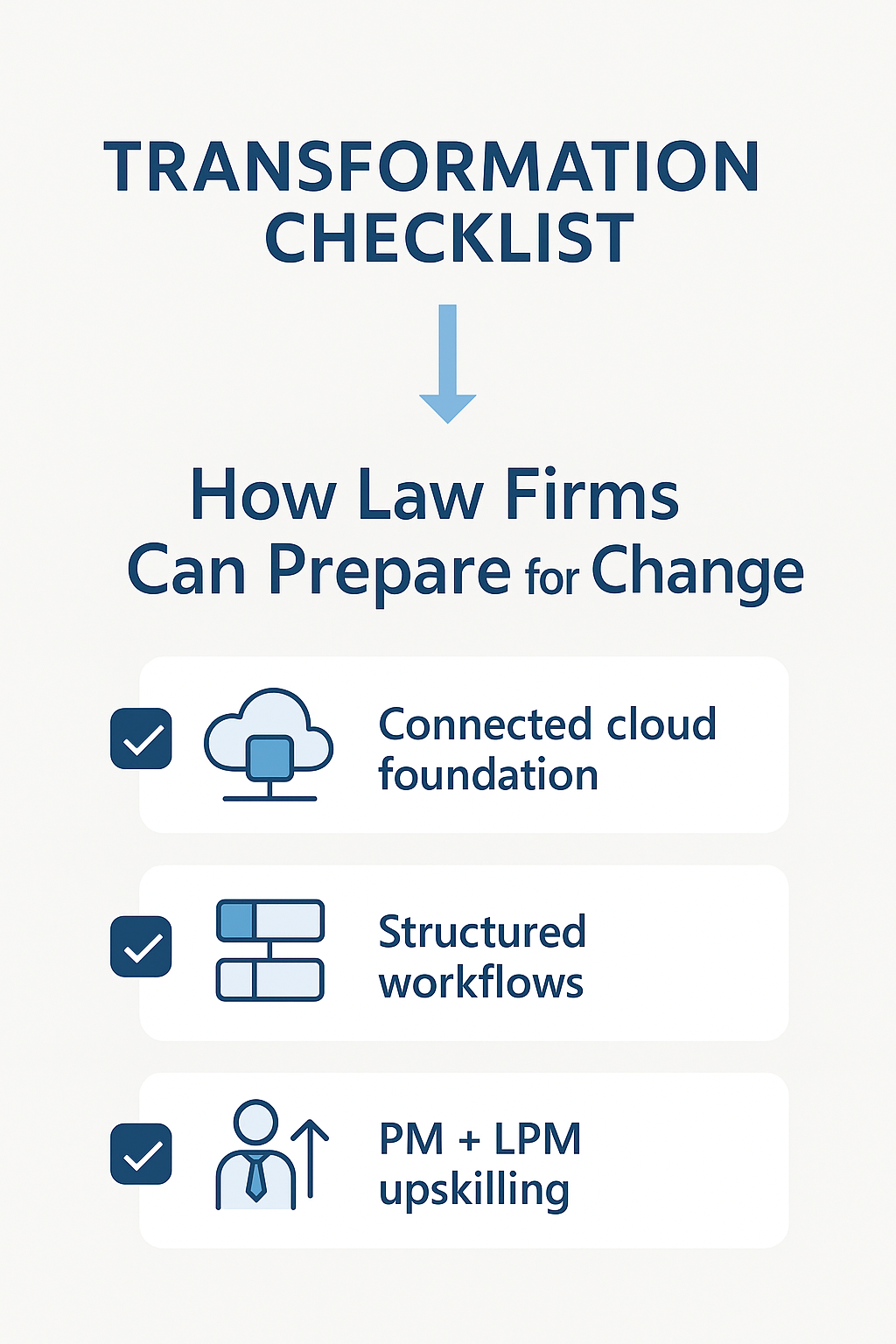
How law firms can prepare for the next stage of change
- Invest in connected cloud foundations
Fragmented systems create inconsistent client experiences. Firms that move to a connected cloud environment gain more reliable access to firmwide data, stronger reporting capabilities and, clearer forecasting insights, ultimately reinforcing their credibility with clients. This foundation also makes it easier to align teams, streamline communication, and support more predictable matter delivery.
- Introduce structured matter workflows
Rather than relying on historic knowledge, firms benefit from checklists and standardized stages for recurring matter types. These structures help teams collaborate more consistently, improve onboarding for new lawyers, and create a more transparent view of how work progresses across the firm.
- Upskill teams in project management
Clients appreciate legal expertise, but they also value disciplined delivery. Training lawyers and support teams in project planning, risk tracking, and communication strategies helps firms meet those expectations more reliably. This shift strengthens internal coordination and improves how matters are managed from scoping through completion.
Positioning for a more connected, client-centric future
As expectations keep shifting, the future of law firms will favor those that combine legal excellence with operational discipline. Firms that adopt integrated technologies, structured processes, and data-driven decision-making will be the ones that consistently meet client demands for transparency and predictability.
This is where the Microsoft Industry Cloud for Law Firms is becoming a game-changer. It brings together legal matter management, collaboration tools, workforce planning, and analytics and global accounting solution for law firms in a single connected, composable, cloud environment. sa.global extends this foundation with legal-specific capabilities that help firms operate more efficiently and deliver a more cohesive client experience.
With a connected operational foundation in place, firms gain the clarity and coordination they need to respond to client expectations with confidence.
This integrated approach helps them sharpen delivery, improve commercial alignment, and build relationships that are resilient even as the legal market evolves.
FAQs
Q. What internal challenges hold firms back from adapting to the future of law firms?
A. Many independent firms struggle not because they lack expertise but because their internal operations rely on fragmented systems, inconsistent processes, and undocumented institutional knowledge. This creates bottlenecks when teams scale, collaborate across offices, or respond to urgent client needs. Addressing these challenges requires firms to standardize how work is delivered, improve cross-team communication, and bring their operational data into a connected cloud environment.
Q. How can smaller or mid-sized firms align to modern legal practice trendswithout large-scale transformation?
A. Modern legal practice trends do not require major overhauls. Smaller firms can begin by adopting structured workflows for their most common matter types, centralizing key operational data, and introducing basic project management habits. Even these modest steps can improve predictability and help teams deliver work with greater coordination. As momentum builds, firms can gradually expand into more advanced tooling and analytics without overwhelming resources.
Q. What distinguishes AI-driven law firmsin day-to-day operations?
A. AI-driven law firms do not rely on AI for legal judgement but for operational intelligence. These firms use AI to spot patterns in workloads, highlight possible delays, and support more accurate planning. The biggest shift is that decisions about staffing, matter progression, and budgeting become more informed and proactive. This enables firms to manage engagements with far more stability and reduce last-minute pressure on teams.
Q. How does technology in legal servicesinfluence client relationships beyond efficiency?
A. Clients increasingly expect their external counsel to provide visibility and commercial alignment, not just timely outputs. Legal tech solutions can enable law firms to provide structured updates, predictable cost expectations, and clear progress indicators, it signals accountability and professionalism.
Q. How should firm leadership prioritize operational investments for the future of law firms?
A. Leadership should prioritize investments that create repeatable value: connected data systems, firm-wide process standardization, and tools that support collaboration at scale. Instead of layering new technology over inconsistent foundations, firms should focus on building operational clarity first. Once processes and data are aligned, more advanced capabilities such as AI-supported insights, forecasting tools, and financial analytics become significantly more effective.
